When you buy through links on our articles, Future and its syndication partners may earn a commission.

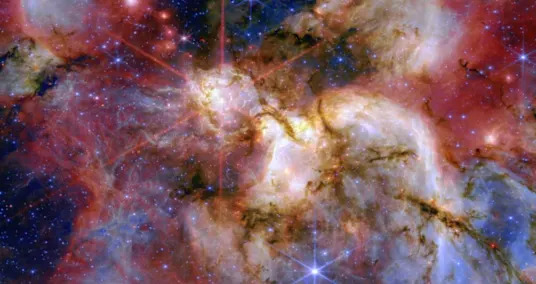
Astronomers have used the James Webb Space Telescope to study the star-forming region called W51, revealing "hidden" stars that were invisible to other telescopes.
The investigation has resulted in some absolutely stunning images that show the lanes of gas and dust illuminated by these young stars in unprecedented detail.
The team behind these observations was able to use the $10 billion space telescope to determine that the stars in W51 began to form within the last million years. If this makes these stellar infants sound ancient, consider that our middle-aged star, the sun, is around 4.6 billion years old.
This is far from the first time that astronomers have captured images of W51, but the JWST observations reveal these young stars like never before.
That is because these still-growing stellar infants are shrouded in natal blankets of gas and dust that readily block and absorb light, preventing most telescopes from seeing them. But infrared light is able to slip through these clouds, and that is the type of electromagnetic radiation that the JWST uses to observe the cosmos.
"With optical and ground-based infrared telescopes, we can't see through the dust to see the young stars," team member and University of Florida researcher Adam Ginsburg said in a statement accompanying the images. "Now we can."

Aside from their considerable aesthetic value, the images are of great scientific interest too. They could help researchers determine how massive stars like those that populate W51 form. The formation mechanism of high-mass stars is much less well understood than that of low-mass stellar bodies.
"Because of James Webb, we can see those hidden, young massive stars forming in this star-forming region," team member Taehwa Yoo of the University of Florida said. "By looking at them, we can study their formation mechanisms."

With the massive leap in quality of the JWST, the team was able to discover hitherto unseen structures in W51. This included shockwaves rippling out from infant stars, giant bubbles of gas, and dark filaments of dust.

"They are not the first photos of this region, but they are the best. They're so much better that they essentially are brand new photos," Ginsburg said. "Every time we look at these images, we learn something new and unexpected."
LATEST POSTS
- 1
 Sarkozy says he owes France 'the truth' as he challenges conviction over alleged Libya funding
 - 27 Odd Apparatuses to Make Your Party Stick Out!
- 3UN mission says no evidence Hezbollah rearming in southern Lebanon
- 4Triumph’s Gorgeous, Super-Affordable and Approachable New Street Motos Share a Heart But Not a Soul
- 5The most effective method to Succeed in Your Profession with a Web based Advertising Degree





- Get To Be familiar with The Historical backdrop Of Western Medication
- NASA wants to build a base on the Moon by the 2030s – how and why it plans to build up to a long-term lunar presence
- From Dread to Certainty: Individual Accounts of Strengthening
- Why is everyone talking about Paul Dano? George Clooney becomes the actor's latest defender in this 'time of cruelty.'
- Stolen Renoir, Cézanne and Matisse were probably uninsured, market sources say
- ‘More should be done’: UN pushes Syrian regime on justice for Druze, Alawites and minority groups
- Earth’s magnetic field protects life on Earth from radiation, but it can move, and the magnetic poles can even flip
- Figure out how to Team up with Your Auto Crash Legal advisor for Best Outcomes
- When is MLK Day? Plus, the dates of when other federal holidays land in 2026.